Wednesday, May 1, 2013

Thursday, April 25, 2013
Top 10 Educational Apps for Preschoolers
September 4, 2012 by — 37 Comments
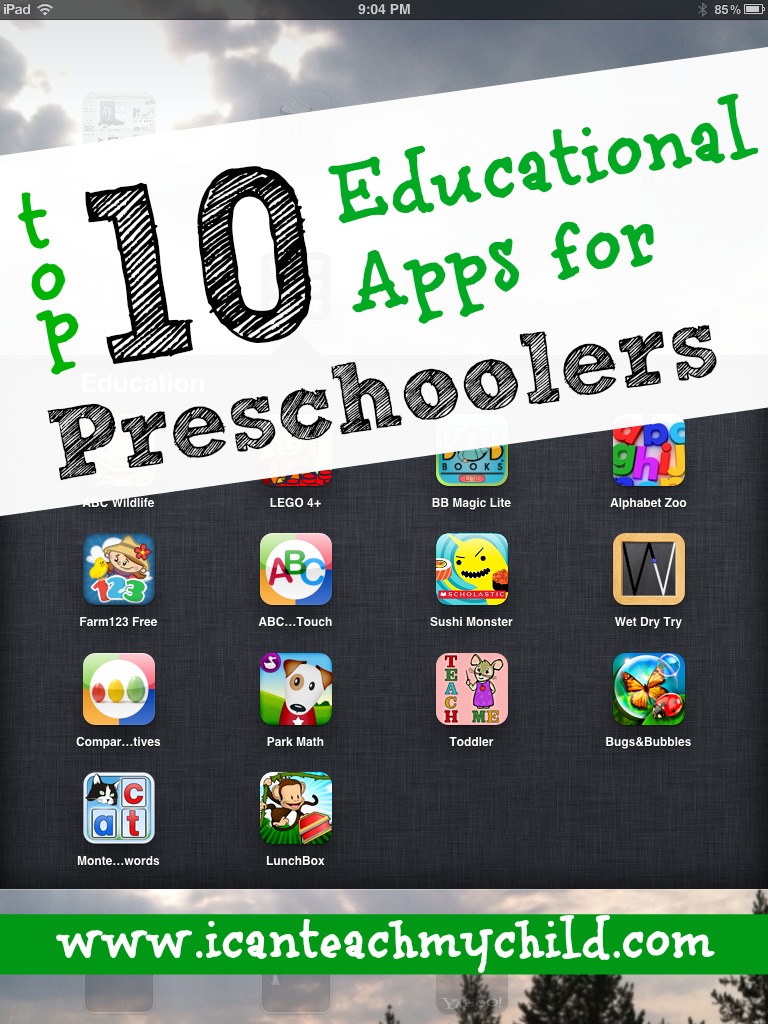
I’m a firm believer in real-life, hands-on experiences to help young children grow and learn…So much so that I have really fought against this whole “kids using iPods/iPads” thing. But I’m giving in–mostly because I know that this is the way of the future and refusing to let my children “indulge” makes them want it even more, to the point where they are obsessive when/if they do get to play. Rather than mindless video-game playing (i.e. Angry Birds, which they’ll still get to play on occasion), I want to harness this technology as a tool for teaching and learning. After hours upon hours of reading reviews and testing more than a dozen apps,I compiled a list of 10 of our favorite iPhone/iPad educational Apps for preschoolers!

I have included 6 favorites that must purchased and 4 that are currently free. Please note, however, that a few of the free apps only have parts of the app available for free.
6 Best Paid Apps for Preschoolers:
1. Montessori Crosswords (designed for iPad and iPhone–$2.99)
This is one of my favorites, probably because it is a great tool for teaching reading (or the phonetic component of reading, anyway). Teaching a child to read is one of my favorite things in the entire world! This app is great for teaching letter SOUNDS (which is WAY more important than learning their names). It also adds a cognitive component of mini-crossword puzzles as well as consonant blends. This app is completely customizable and includes a special section for parents.

2. Handwriting without Tears: Wet, Dry, Try Capital Letters and Numbers (iPad 2 and newer only–$4.99)
If you are familiar with the Handwriting Without Tears curriculum, you will appreciate this app! It is an electronic version of the Wet-Dry-Try activity that is a core component in this curriculum. It teaches children to form letters from the top down. Although using this app is quite different from holding a pencil and writing (unless you have your child use a stylus), it at least allows children to learn how to correctly form a capital letter (and numbers). My only complaint about this app (besides the fact that it is ridiculously expensive and only includes capital letter formation) is that it can be frustrating for younger children. Little Brother attempted it and he obviously did not have the fine motor control necessary, so it would make him start over again and again. I would suggest this app for children who are 4+. It is perfect for Big Brother and keeps me from harping on him all the time to begin writing his capital letters from the top down!

3. TeachMe Toddler (Compatible on iPhone, iPod Touch, and iPad–$0.99)
This all-in-one app works on letters, numbers, shapes, and colors (which I think is great for young preschoolers/older toddlers). If you have a preschooler who is ready for more of a challenge, the Teach Me Kindergarten App ($1.99) would be a great step up! The Kindergarten app includes addition, subtraction, spelling, and sight words! Each child has their own log-in and you can track their progress. The interface is pretty simple, which I personally prefer for my children–some other “busy” apps can be overstimulating. This app can be a little drab if playing it for a while, but it is still something I would recommend.

4. Monkey Preschool Lunchbox (designed for both iPod and iPad–$0.99)
This is the most popular preschool app available, with good reason! At 99 cents, it offers a lot of bang for its buck! The puzzle feature (below) is great for incorporating visual/spatial awareness while you’re on the go (without losing a million puzzle pieces in the process). It also includes sorting, shape recognition, and color recognition…just to name a few.

5. Park Math – Duck Duck Moose (compatible with iPad, iPod touch, and iPhone–$1.99)
This app provides valuable content and is engaging to young children. The bear on the roller skates strolls from task to task, including sorting from smallest to largest, patterning, number recognition, counting, and addition. The graphics won’t wow you, but they’ll keep your child entertained while learning.

6. Bugs and Bubbles (Designed for both iPod and iPad–$2.99)
This app, along with its companion app (Bugs and Buttons–same price), are the most beautiful children’s apps I have seen! The graphics are incredible! This app, in my opinion, is the perfect blend of fun and learning. Some of the tasks are solely for fun (popping bubbles) while others include important early-learning tasks such as patterning, letter matching, letter writing, and shape recognition. I also really like that every game starts at the easiest level and as the child masters it, it goes to harder levels.

The Best FREE Apps for Preschoolers:
7. PBS Kids Video: Although this is less of an app and more of a portable movie player, it is still nice to have! Watch more than 1,000 videos from your favorite PBS Kids shows anytime, anywhere (with Wi-Fi) in the US! Great for doctor’s appointments and airplane rides (just don’t forget the headphones).

This interactive pop-up book allows your little one to count, but won’t let him/her recount an object that has already been counted, therefore helping to increase a child’s one-to-one correspondence ability. Some of the games are locked until you purchase the app, but the book portion alone is worth downloading.

If you don’t want to pay for the Handwriting Without Tears App, this is a great (and FREE) alternative that helps your child learn how to form their letters in a fun and interactive way. Like the HWT app, it would be even better if you had your child use a stylus. I also really like this one because it includes lowercase letters as well (unlike the Handwriting without Tears app).

Many of you shared on Facebook that you loved the Starfall Apps. But when I read the reviews, there seemed to be a lot of negative comments about how expensive the App was for ONE game (out of dozens) that are free on the Starfall website (that can’t be used on iPads/iPhones due to no flash players). Rather than paying for a Starfall app, I followed the recommendation from Ashley of Life with Moore Babies and downloaded Rover–which makes websites with flash players (like Starfall) accessible and usable!

A Few Runner-Ups
Free:
Alphabet Zoo: This simple flashcard-like app goes through every letter of the alphabet, saying the letter name, its sound, and an object that corresponds to it.
Paid: I didn’t purchase these apps and try them out, but they came recommended byreaders on my Facebook page.
ABC Wildlife ($2.99): We downloaded this one when it was free about a month ago. I REALLY like it and would recommend it. Each letter has several real animal examples with letter sounds, games, and videos about the real-life animal.
A FINAL WORD: Please remember that iPhones and iPads are just like computers–meaning that you must be vigilant about ensuring your child isn’t exposed to any inappropriate content. SecureMama shares a step-by-step guide for ways to secure your iPhone or iPad. Read and implement these suggestions!
Sunday, April 21, 2013
Choosing the Right Preschool Program

Madison is bored at home, and she doesn’t enjoy her playgroup anymore. Her parents think she is ready for something different, a place where she can play and make new friends, where she’ll learn what she needs to know to be ready for kindergarten. It’s time to find a preschool for Madison. But how do they find the right preschool for her?
Starting preschool is a significant event for every child. For many, it is the first time they are routinely away from home and their parents, so it is a big step toward independence. It is also an important milestone for parents who may find it difficult to see their children growing up and beginning to have important experiences without them.
Choosing the right preschool may seem daunting. Parents want to find a place where they can trust that their children will be happy, where they will grow and learn and enjoy the other children and adults. But parents also want to find a preschool where they will feel welcomed and included, and the program must be convenient and affordable.
Are the children happy? Are they interested and involved in the activities, or are many of them wandering aimlessly around the room looking for something to do? Are they able to manage their own behavior, or are they dependent on the teachers to keep them focused and out of trouble? Do they seem to like the teachers or do they avoid them? How do they act toward each other?
Finding the right preschool can be complicated, but it is made easier by following five basic steps:
STEP 1: DEFINING INITIAL CRITERIA
What does your child need and what are your expectations? Before the search begins, think about your child and consider what is compatible with who she is and what she needs in a preschool program. Then think about your expectations. Your child’s needs and your expectations become the initial criteria for evaluating programs.
In the following example, notice how Madison’s parents accomplish this.
Her parents realize that Madison is a very busy child. She loves to explore everything, especially when she can share her discoveries with someone. She loves to play. Madison's also imaginative. She dictates elaborate stories and often plays dress-up, pretending to be characters from her favorite books. Sometimes she tries to count as she’s playing with her blocks, and she’s learning the letters in her name. She likes to learn things in her own way.
Madison’s parents begin the search for a preschool where she’ll be able to play and participate in a wide variety of activities. They will look for a place where the teachers are sensitive, kind and will enthusiastically support Madison as she learns. They want to find a preschool that prepares her for kindergarten, and one where the other children are friendly and Madison will be happy. They also want to find a preschool that is conveniently located and within their budget.
So, Madison’s parents have decided on their initial criteria for evaluating a program. They will look for a preschool that offers Madison opportunities for play and individualized learning. They will look for a preschool that prepares Madison for kindergarten, is close to home and not too expensive.
STEP 2: FINDING PROGRAMS IN YOUR AREA
To find preschools in your area, ask friends for suggestions, explore resources at the library and search for local preschool programs on the Internet. From your search, you’ll find a variety of programs including structured academic, play-based, Montessori, parent co-ops, and more. (Descriptions of different types of program are also online.)
After selecting a couple of preschools to explore further, schedule interviews with the directors and arrange to observe the classrooms.
STEP 3: MEETING WITH THE PRESCHOOL DIRECTOR
During this meeting, the director will typically explain the program philosophy and how it is implemented in the classroom. In addition, she will describe any specific program policies (i.e. expectations for parent participation, early drop-off and late pick-up), as well as cost and billing schedules. You will also learn about the teachers' qualifications and experience, and about any accreditation, certification, ratings or special awards earned for program quality. You should feel comfortable asking any questions you have about the program.
STEP 4: OBSERVING IN THE CLASSROOM
This is a critical part of the decision-making process because you will see the program in action. As you observe, try to imagine your child in the classroom.
While observing, notice the materials and activities available in the room. Will they be interesting and challenging for your child? Is there enough to do so she won’t be bored, but not too much that she might be overwhelmed?
Notice how the teachers act toward the children. Are they engaged with them in many activities, or is their involvement focused on resolving conflicts and discipline? How do they teach? Do they teach informally using questions and discussion or do they teach using formal lessons with worksheets, repetition and rewards?
Also observe the children. Are they happy? Are they interested and involved in the activities, or are many of them wandering aimlessly around the room looking for something to do? Are they able to manage their own behavior, or are they dependent on the teachers to keep them focused and out of trouble? Do they seem to like the teachers or do they avoid them? How do they act toward each other?
Step 5: MAKING THE CHOICE
After gathering all the information, it’s time to make a choice. Reflect on what you learned and answer these questions:
Did you like this program? Would you want your child here? Why?
Then think more specifically about how the program measures up against your criteria.
How does this program meet your child’s needs?
How does this program meet your needs and expectations?
When you are comfortable with a program and determine it meets your and your child’s needs and your expectations, then you’ve probably found the right preschool. Now you can confidently make your choice.
M. Therese Gnezda is an early childhood consultant and conducts parenting education workshops in the Washington, D.C., area.
Friday, April 19, 2013
Does imitating a teacher limit children’s exploration during play?

It is no surprise that children learn quickly by watching others, but previous research had shown that children are also good at spontaneously generating their own evidence during play. This study asked: How do children’s desires to imitate a teacher affect their ability to learn on their own during play?
Children, aged 4-5 years, played with a novel toy in order to figure out how it works. The toy had four hidden causal properties: a tube that made a squeaking sound when it was pulled, a button that turned on a light, a mirror hidden inside another tube, and a pad that played music. In one condition, the researcher first demonstrated one of the causal properties of the toy – she made the toy squeak by pulling on the tube. In another condition, the researcher either “accidentally” discovered the same property of the toy, or was interrupted while she was demonstrating how the toy worked. In a third condition, children received no demonstration – the researcher simply looked at the toy. In all conditions, children were then allowed to play with the toy on their own.
After playing, children were asked to demonstrate the different causal properties of the toy. We predicted that children who received no demonstration would discover most of the causal properties of the toy on their own. However, we predicted that children who had seen a demonstration of one of the toy’s functions would imitate only the action demonstrated, and would be less likely to discover the other properties of the object. Children in this condition might assume that their “teacher” showed them everything that the toy could do.
We found that children notice when others attempt to teach them about how things work, and that they use information provided by adults to guide their explorations of the world. Children in our study spent less time playing with the toy when the researcher demonstrated how it worked, compared to when the researcher discovered the same property accidentally or when she was interrupted before she could finish the demonstration. This was true even when children simply overheard the researcher demonstrate how the toy worked for another child. Children who didn’t receive any demonstration played with the toy longer, and discovered more of the other properties of the toy.
This research shows that when adults give explicit instructions to children, kids often imitate only the actions demonstrated. While this is a valuable skill when children are in classroom settings, they may learn more through free play when adults allow them to explore objects on their own.
This research is conducted by MIT - Early Childhood Cognition Lab.
Wednesday, April 17, 2013


Wednesday, April 10, 2013
Positive Thinking
| |||||
Wednesday, April 3, 2013
Some Inspiration
Look for your favorite things,
and never complain about anything.
Look for the thing that you like the best,
even if there was only one thing
in all of it that you like,
give it your undivided attention-
and use it as your excuse to be who-you-are.
And as you use those things
that shine bright and make you feel good
as your excuse to give your attention and be who-you-are,
you will tune to who-you-are,
and the whole world will begin to transform before your eyes.
Abraham-Hicks
and never complain about anything.
Look for the thing that you like the best,
even if there was only one thing
in all of it that you like,
give it your undivided attention-
and use it as your excuse to be who-you-are.
And as you use those things
that shine bright and make you feel good
as your excuse to give your attention and be who-you-are,
you will tune to who-you-are,
and the whole world will begin to transform before your eyes.
Abraham-Hicks
Subscribe to:
Posts (Atom)